
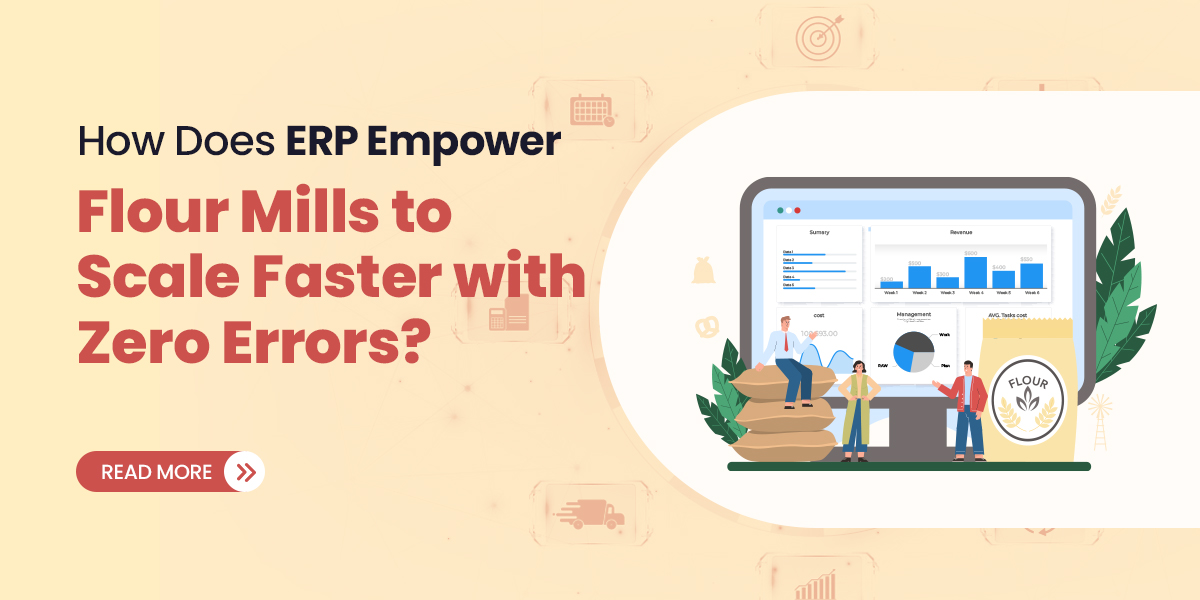

Flour mills operate on speed, precision, and consistency—and even slight variation in production, stock, or quality may affect the whole chain. Manual systems prove ineffective as the demand increases and customer expectations do too. This is where a new ERP for flour mills takes on a new game. ERP technology enables the flour mills to grow without hesitation with automated workflows, real-time monitoring, and quality data at every stage of the process.
Why Does ERP Minimize the Daily Mistakes Flour Mills Are Having Problems With?
The old-fashioned flour mill procedures are reliant on manual record keeping, verbal messages, and separate information systems. These loopholes result in recurrent mistakes in batch mixing, inventory handling, and tracking orders. An ERP software for flour mills helps to fill these gaps by interlinking all departments, such as grain procurement and final dispatch, into a single system.
Live validation, automatic updates, and electronic records eradicate inaccuracies, making the teams remain accurate even when the production is at its highest. Having fewer errors, mills will be able to achieve the deadlines quickly and preserve close relations with customers.
What is the point of a growing flour mill having real-time visibility?
When the decision-makers are unable to observe what is happening in the mill at that very moment, scaling becomes an issue. Flour mills ERP software gives real-time access to stock status, batch status, machine status, and employee efficiency.
It could be the identification of a raw materials shortage at an early stage or the trace of finished goods movement; managers are always informed without relying on manual reports. Such transparency assists mills in preventing time wastage and designing correct production cycles, and also eliminates wastage of finances due to downtime.
Automated Production: The consistency of each level
The current ERP for flour mills system makes all batches of the same recipe and quality using the same standard to get the same flour. Auto-production alternative eliminates conjecture and enables the mills to schedule their production to match the demand, seasonal developments, or custom orders. The workflow and computerized instructions allow the operators to understand what to do and when to do it.
Flawless inventory management eliminates wastage and stockouts
One of the largest scaling challenges is inventory mismanagement. ERP maintains accurate records on the raw material, in-process goods, and packed goods, and nothing is left unnoticed. It warns teams in case materials are under the necessary level, it monitors expiry dates, and it assists in making predictions about future needs through previous trends. The flour mill is healthy in profit margins by not overstocking or wasting its finances, and is able to keep all orders on time.
Conclusion
Mill track recorders for the real-time tracking, accurate workflows, and automated planning of production will enable mills to expand at a higher rate without losing quality or efficiency control. To have trusted, effective implementation, professional guidance, and functions aligned to the industries, it is recommended to consider working with Global Infocloud to unleash smarter and seamless ERP software for flour mills that suit flour manufacturing.