
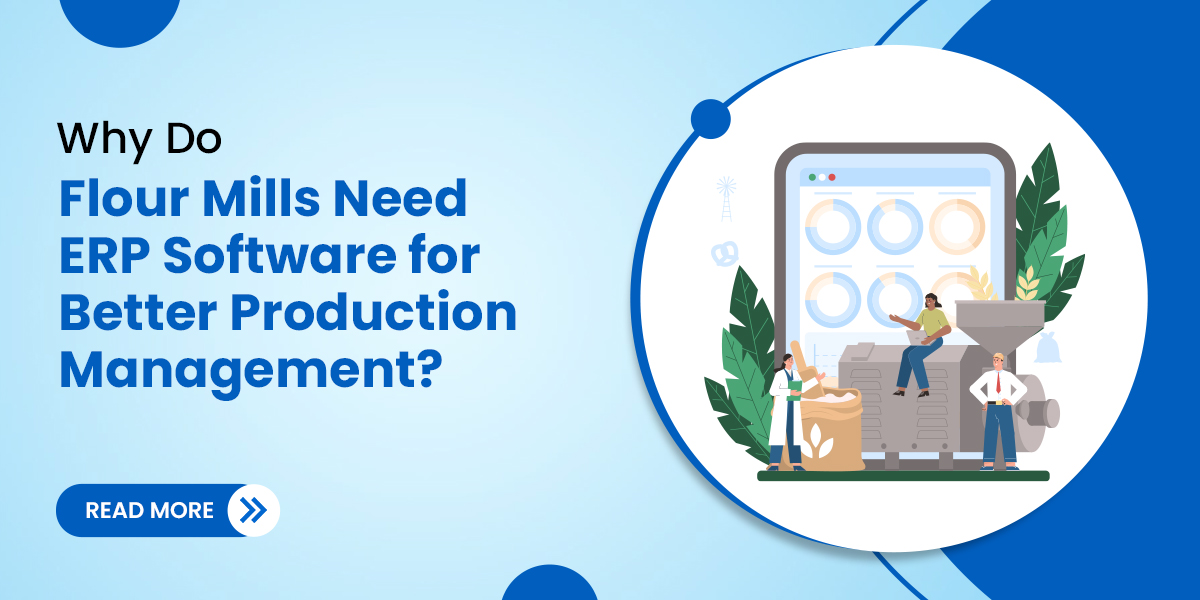

Flour mills are involved in a production setup that is highly fast-paced and requires efficiency, accuracy, and consistency. Since raw grains are obtained and processed into grains, then packaged and distributed, all these processes should be handled with concern to ensure the product is not spoiled during the operations and the costs of operations are minimized. A manual way of managing these activities may cause delays, stock-holding mistakes, and ineffective production planning. At this point, the ERP for flour mill will come in handy.
What production problems is ERP able to resolve in flour mills?
ERP software assists in streamlining operations by enhancing visibility and automating them for ERP for better production management.
- The production monitoring in real-time is useful to monitor the output of milling and identify operational inefficiencies in a short period.
• Granting automated workflow management enhances coordination among the stages of grain cleaning, grinding, and packaging.
• Proper inventory management will avoid shortages of raw materials when there is high demand for production.
• Planning tools based on data are useful in maximizing resource usage and minimizing the time spent during production.
Critical ERP Modules in Flour Mill Operations.
In order to ensure the normal daily running of the mills, the ERP solution of the flour mills provided by an ERP software provider focuses on the features that make it easy to manage production, keep track of the inventory, and coordinate the supply chain.
- Management system of inventory.
• Production scheduling programs.
• Raw material tracking
• Quality control modules
• The procurement management tools.
• Warehouse stock visibility
• Monitors financial reporting.
• Order management system
What Does ERP Do to Inventory and Supply Chain Management?
The management of inventory is very important in the flour mills since raw grains should be well stored and utilized effectively to ensure continuity in production. ERP software for flour mill assists mills in monitoring inventory and the scheduling of procurements, as well as the movement of materials through the storage and processing facilities.
How Important Is Data-Driven Decision-Making to Flour Mills?
The current flour mills are based on the correct data to retain productivity and costs. The ERP system is also a source of great information that can be used to make wise decisions by the managers.
- The uniformity of data reporting is better in terms of visibility in production, procurement, and inventory management activities.
• Mill automation regarding analytics is used to find inefficiencies and optimize milling operations to increase productivity.
• Machine utilization and output levels are in real time and can be seen on performance dashboards.
• The analysis of historical data would help to plan the production needs in the future.
Conclusion
Through the strategic combination of main functions like inventory tracking, producing schedules, supply chains, and performance monitoring, the mill can decrease the number of mistakes in the work and enhance the overall output with ERP for flour mill. Companies that are interested in adopting an effective ERP solution to help manage flour mills can utilize the solutions proposed by Global Infocloud, which can be used to promote improved production and efficient operation.