
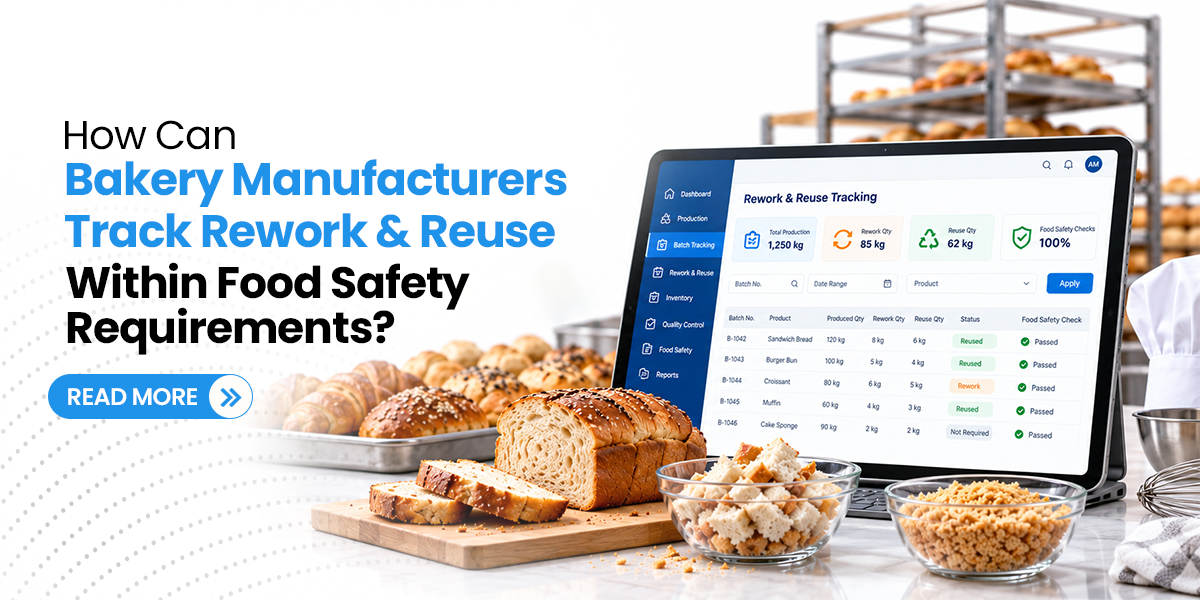

Many bakery manufacturers end up with rework because of product failure, batches above or below the specifications, or unused dough in the production process when using an ERP for bakery. Reuse of appropriate materials can help minimize waste and help to increase production efficiency, but it can also present food safety hazards if it is not controlled. Plans should be established by manufacturers to identify, track, record, and evaluate all rework batches.
Why is it important to track rework in bakery production?
Rework tracking will assist the manufacturer in determining the source of the rework and/or rejection and whether it can be reused. If there are no records, inappropriate ingredients or products could be added to subsequent batches, leading to traceability and quality issues. A structured bakery management system will facilitate more effective control by using the following measures:
- Batch identification
- Rework quantity records
- Time and temperature logging
- Ingredient traceability
- Approved reuse procedures
- Documented staff responsibilities
These records provide a means for teams to ensure that rework is properly managed and to identify issues if a quality or safety issue occurs.
How to avoid rework without sacrificing food safety in bakeries?
All rework items should be evaluated prior to their return to production. It needs to be a source that complies with the bakery’s documented food safety procedures, have a documented handling history, and be stored in a manner that complies with those procedures.
- Such unique batch references assist operators in identifying the batch that the rework is from.
- Keeping a record of collection times and storage conditions can facilitate a determination of whether material is suitable for reuse.
- Limits of reuse that are agreed upon reduce the risk of rework spoiling the product and/or causing variability in the product.
- By separating allergen-bearing materials, the risk of unintended allergen cross-contact during collection, storage, and re-use is minimised.
Only re-use rework that can be identified, properly controlled, and in line with validated procedures of the product. Any material that has an unknown history, contamination concerns, and/or inappropriate storage conditions should not be returned to production.
What are some records that can help to ensure traceability and compliance?
A reliable food safety documentation system supported by ERP software for bakery links the handling of rework to the bakery’s food safety management system. Records shall indicate the source, quantity, location of collection, storage location, and which completed batch it was sent to. Documentation of approvals, quantities re-used, and any decisions made about disposal should also be made.
Regular reviews assist in the detection of waste that keeps happening, inconsistencies, and staff training gaps. These controls contribute to traceability and assist the bakery in demonstrating how rework decisions are made according to a procedure.
Conclusion
In the bakery industry, the effective management of rework enables the achievement of food safety requirements and the efficient use of resources. A well-documented process involves manufacturers in minimizing waste while maintaining product safety. Global Infocloud can assist bakery manufacturers with an ERP Solution to digitize production records, enhance traceability, and manage rework management processes.