
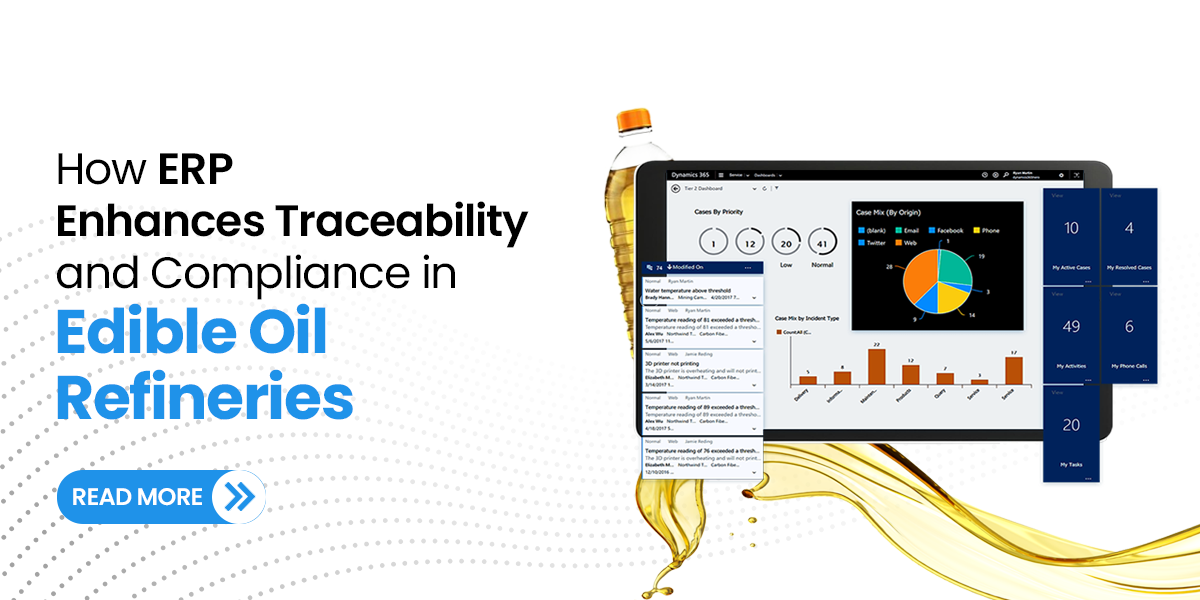

It is highly regulated, with the maintenance of the quality of the products, compliance requirements, and food safety being essential for an edible oil refinery. A lack of interoperability between systems can make the management of raw materials, production batches, quality checks, and regulatory documents more complex and prone to errors. An ERP for Edible Oil Industry solution can simplify these processes by making data centralized and improving the visibility of the oil refinery. An enhanced information control will help refineries to improve traceability, reduce the complexity of compliance management, and ensure supply chain confidence.
Why is traceability important in edible oil refining?
Product traceability is important in maintaining product quality and transparency throughout the product manufacturing process. It is possible to track the materials and products through the various stages of the refinery process with the help of an oil refinery software ERP system.
- Batch-level tracking
- Raw material visibility
- Product movement monitoring
- Supply chain transparency
- Quality record management
- Faster issue identification
- Improved accountability
What are the ways ERP helps with regulatory compliance?
To abide by industry standards, you’ll need accurate documentation, monitoring, and reporting. Many activities that are related to compliance are automated with ERP systems, which helps to save time and effort in administration and also increases the accuracy through ERP software for Edible Oil Industry.
- Automated recordkeeping ensures data is maintained in a way that aids in accurate documentation of compliance in all operations.
- Real-time data collection helps assure consistency with regulatory requirements.
- Centralized information helps with efficient access to information during audits and inspections.
- Manual compliance management processes can lead to errors, which are avoided with digital workflows.
- Automated reporting streamlines the reporting of regulatory and quality records.
Encouraging better confidence in data management through building. Building confidence in better data management…
An ERP solution provides a single, integrated resource that enables the collection and retrieval of all operational, quality, and compliance information. This consolidated strategy will help break down the information silos and enable teams to access accurate and current information. Having reliable data in each department in the edible oil refinery helps in coordination between the procurement, production, quality assurance departments, and the distribution department. With the ability to better manage data, traceability and compliance become easier, but so too does the process of making decisions and improving the efficiency of operations across the refinery.
What other advantages can ERP offer to refineries?
In addition to providing traceability and compliance, ERP systems also have some benefits that can enhance the workflow of an edible oil refinery.
- Improved inventory control
- Enhanced production planning
- Better quality management
- Reduced operational errors
- Streamlined business processes
- Faster decision-making
- Increased operational efficiency
Conclusion
In an edible oil refinery, ERP solutions can help to ensure compliance and traceability by providing better visibility of data, automating recordkeeping, and meeting regulatory needs. They enable organizations to keep track of the process accurately and minimize efforts in compliance management. Global Infocloud ERP for Edible Oil Industry solutions are tailored to meet the needs of edible oil refineries looking to take control of their operations and become more regulatory-ready while simultaneously enabling sustainable business growth and development.