
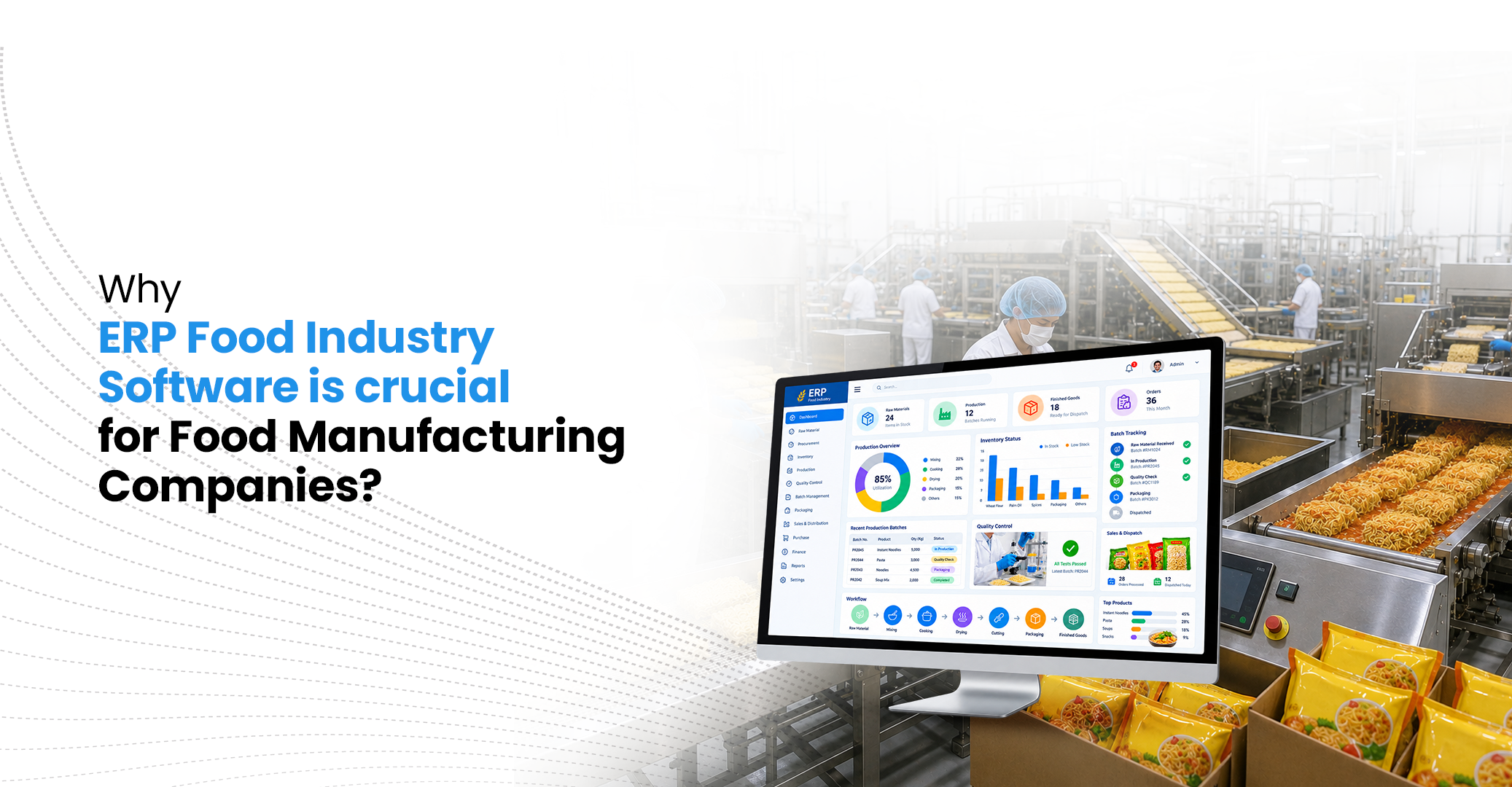

The food manufacturing process has several stages: purchasing raw materials, planning food production, food quality control, food packaging and distribution. Operating these activities with various systems or spreadsheets can make operations complex and error prone.
That’s why ERP food industry software is a significant solution for present-day food manufacturers. It integrates various aspects of business into a single platform that enhances the efficiency of manufacturers, manage costs and aids in making informed business decisions.
1. Centralizes Food Manufacturing Operations
A food manufacturing enterprise provides with information from numerous departments. There needs to be collaboration between the production, purchasing, inventory, sales, finance, and warehouse teams.
These functions are integrated with each other and form a single centre to manage the business information through an ERP system. This will help to minimize reliance on separate documents and facilitate interdepartmental cooperation.
2. Improves Production Planning
Food manufacturers must make the proper quantity, at the appropriate time. It can lead to wastage due to overproduction or stock shortage due to underproduction, and delayed orders.
ERP for food & beverage (F&B) enterprises can assist manufacturers in production planning, taking into account customer orders, stock levels, past sales and resources.
This provides a more efficient production schedule and enables businesses to be more responsive to variations in demand.
3. Provides Better Inventory Management
Food manufacturers process huge volumes of raw materials, packaging materials and the final product. Some ingredients are also ‘perishable’ and should be carefully managed for stock.
ERP for food and beverage industry operations can give real-time visibility of:
- Raw material stock
- Finished goods
- Packaging inventory
- Batch information
- Expiry dates
- Stock movement
- Reorder requirements
This helps businesses not to have too much stock and too little inventory.
4. Can help control food manufacturing costs
The production costs may differ due to the fluctuation in the price of ingredients, labour, energy, packing and wastage.
ERP software can integrate the production and inventory information with the costing information. Manufacturers can track how much material is being used, what the production costs would be, as well as product costs to see where their money is going.
Enhanced cost visibility can help to improve accuracy in cost and profitability analysis.
5. Supports Batch & Lot Traceability
It is especially crucial in the food sector to have batch traceability. Manufacturers should be informed of the materials used in a specific manufacturing run and the distribution of the finished products.
The ERP food industry products can keep lot and batch data throughout the entire manufacturing process. This enhances traceability and can facilitate businesses in their ability to respond quickly and efficiently to quality problems or product recalls.
6. Minimises waste and losses in the manufacturing process
Wastage of food can impact profitability. Rising ingredients costs can be caused by production losses, incorrect ingredients use, overproduction and the use of expired ingredients.
ERP software aids in manufacturing comparison of anticipated material usage and actual usage and production. This helps to detect losses that are out of the ordinary, and to manage resources better.
7. Improves Procurement and Supplier Management
Urgent procurement is crucial to ensure continuous production of food.
ERP software can enable businesses to keep track of their purchasing needs, supplier details, purchase orders, incoming material information, and procurement history.
Manufacturers can match the inventory level with the purchase process so that they can make better-informed purchasing decisions and minimize the possibility of production delays.
8. Supports Demand Forecasting
Food demand may vary due to seasonal, festive, promotional, market and customer preferences.
Historical sales and inventory information can be utilized in an ERP system to aid in demand forecasting. Good forecasting can enable manufacturers to match the production and purchasing with the anticipated demand.
9. Facilitates Real Time Business Reporting
There is a need for accurate information for fast decision making in food production. ERP software can offer reports on:
- Production
- Inventory
- Sales
- Purchasing
- Wastage
- Product costing
- Batch performance
- Profitability
There is no need for management to be manually collecting data from various departments, but instead, they have a centralised source of data which is quicker for them to analyse.
10. Supports Business Growth
As a food manufacturing business expands, dealing with extra products, warehouses, manufacturing lines, customers, and places becomes increasingly complicated.
An ERP system that can be scaled for food & beverage operations can offer a structured system that can expand as the food business expands. It can be used to help manufacturers keep better control as the number of products manufactured and the amount of needed production increases.
Conclusion
The significance of ERP food industry software is that in the food manufacturing industry, the production process is highly dependent on the coordination of all other processes, such as inventory, purchases, sales, finance, and quality.
These features can be combined to enhance production planning, inventory management, batch traceability, production costing, procurement, demand forecasting and reporting for food and beverage industry businesses.
Food manufacturers aiming to overcome the challenges of disconnected processes and integrate a single management system can find a specialized ERP solution to bring them visibility and control, thereby enhancing their efficiency, minimizing waste, and enabling sustainable business growth.