
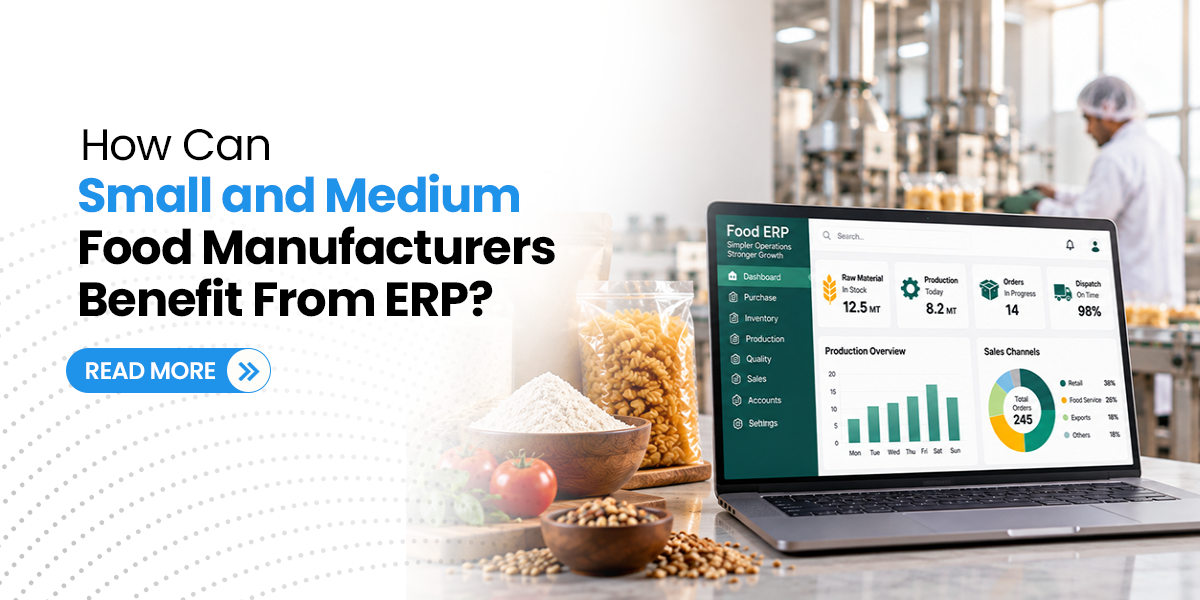

Small and medium food manufacturers typically have to manage business functions like purchasing, production, inventory, quality assurance, selling, and delivery with a very small group of people. When orders are increasing, working out these tasks in separate spreadsheets soon becomes expensive and time-consuming and leads to wasted ingredients, miscounts, and delays. All these dots come together under an Enterprise Resource Planning (ERP) system to provide plant managers with greater visibility into plant operations and more control of the bottom line with ERP for Food Manufacturers.
What are the challenges ERP can help food manufacturers tackle?
It is difficult to maintain batch consistency, and it can be easily impacted by supplier failures if done by hand. These day-to-day tasks are all connected within a single screen with an ERP system, supported by an ERP software provider.
- Centralized business data
- Inventory monitoring
- Production scheduling
- Purchase management
- Quality control
- Order tracking
- Cost monitoring
- Delivery coordination
How can ERP help you optimize production and inventory management?
When you have full visibility of the raw materials that are available in the shop-floor warehouse, planning shop-floor runs becomes a lot easier. With an ERP, you can keep your operations team in check between incoming orders and your current stock and avoid unpleasant shutdowns and spoiled inventory with ERP for food and beverages.
- Real-time inventory visibility alerts for ingredient shortages before they reach the mix line.
- Production planning maps show available machinery and workers, directly countering customer orders.
- Automated stock updating eliminates the manual logbooks and ensures accurate counts.
- Batch tracking will track ingredients from the supplier’s truck, through the kitchen, to the store shelf.
In what ways can ERP help improve food quality and compliance?
If an auditor visits or a customer brings up an issue, you can track a specific batch back to its origin in minutes as opposed to sifting through boxes of old clipboards. In case of a need for routine compliance checks, having good records to hand keeps you in good stead and will help protect your brand with ERP software for food and beverages industry.
How can ERP enable small manufacturers to make better decisions?
Real-time numbers give owners clear, real-time information: Real-time numbers change how owners operate their facilities. Decision makers get a clear view of actual yield costs, margin decreases, and inventory issues without waiting until the end of the month and creating a mess with spreadsheets.
- Improved information access in operations.
- Improved knowledge of the costs of production as they occur.
- Better demand forecasting and raw material planning.
- More convenient waste identification and line bottleneck detection.
The transparency in the level of operation allows manufacturers that are growing, to correctly position their products in the market, meet the large orders of the retail stores, and expand their operations without taking unnecessary risks with F&B ERP software.
Conclusion
An ERP system for growing food manufacturers creates an orderly, timely, and real control of day-to-day plant operations. Connects your supply chain, mixing schedules, quality checks, and shipping docks into one system. When it comes to software support to establish a streamlined and efficient food processing system, Global Infocloud offers the experience you need.