
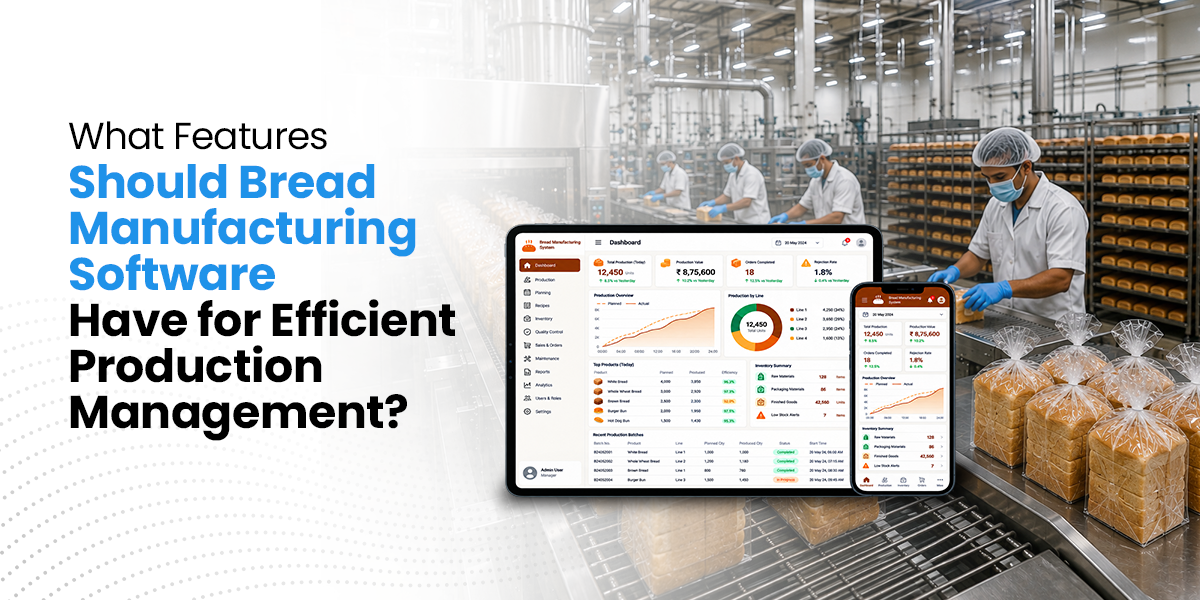

To manage the bread manufacturing process efficiently, bread manufacturing software should possess certain features.
There are several time critical processes in the bread manufacturing such as preparation of ingredients, mixing, proofing, baking, cooling, packing and distribution. When these activities are carried out manually, it becomes challenging to have a production schedule, inventory control, minimize wastage and ensure quality control.
Therefore, it is crucial to select the appropriate software in the bread manufacturing industry, to enhance the efficiency of production. Ideally, it should be able to integrate production, inventory, procurement, quality, warehousing and reporting into a single system.
These are some of the essential features companies need to take into account.
1. Production Planning and Scheduling
One of the key capabilities of bread production software is its production planning capabilities.
The system should assist the manufacturers in the following ways:
For planning – Both Daily and Batchwise production.
Plan manufacturing to meet customers’ needs
- Monitor production progress
- Allocate available resources
Examine and contrast expected and actual production
Overproduction or stock shortages can be avoided by demand based planning, which can be done by bakeries.
2. Recipe and Ingredient Management
There are various different types of bread, which can’t be made in the same way with the same amounts of ingredients. The software should enable manufacturers to have a standardised recipe as well, and be able to monitor the amount of product needed for each batch.
This will help to create more uniformity in recipes, determine ingredient quantities and accurately estimate costs of production.
3. Real-Time Inventory Management
Raw materials, such as flour, yeast, sugar, fats, additives, packaging materials and others must be ready for production.
An efficient ERP system should be able to offer real-time stock visibility and assistance:
- Stock-level monitoring
- Reorder-level management
- Material issuance
- Warehouse transfers
- FIFO/FEFO inventory rotation
- Expiry tracking
This helps minimise production downtimes due to shortage of materials.
4. Batch and Lot Traceability
Bread manufacturing software should be able to monitor raw materials, finished products per batch/lot.
This enables manufacturers to trace all the ingredients in one production batch, identify them and track them. It can help in quality control, quicker issue investigation and in case of a product recall, it can also facilitate in managing the product recall.
5. Shelf-Life and Expiry Management
Bread is a very perishable product and freshness and rotation is of paramount importance.
Monitoring production dates, expiry dates and remaining shelf life should be done by the software. Use of automated expiry alerts and FIFO/FEFO practices can be used to help prevent spoilage and to ensure that the older stock is used appropriately.
6. Demand Forecasting
The demand for bread is subject to variation throughout the week, seasons and festivals, promotions and local buying habits.
A modern ERP should be able to review transactions and take that into account to inform manufacturers of future needs. Improved forecasting can be used as an aid to production planning and can minimize overproduction.
7. Waste and Yield Management
Loss of ingredients and losses due to production are directly related to profitability.
Bread manufacturing software should monitor the amount of materials used, planned materials, actual production and waste produced. This enables manufacturers to find their way to production inefficiencies, and optimize yield over time.
8. Quality Control and Compliance
Food manufacturers need to have a quality management system. ERP should facilitate the quality checks, inspection records, production documentation, and traceability.
Digital records also can help streamline food safety and regulatory compliance documentation, like FSSAI, HACCP, and ISO.
9. Costing and Financial Visibility
There should also be a connection between the production and costing to enable businesses to know the cost of production of different bread products.
Monitoring and tracking ingredients, production costs, wastage and other costs can assist manufacturers in assessing margins and determining better pricing decisions.
10. Real-Time Reporting
Managers require precise information to enable decisions to be made in a timely fashion. Bread manufacturing software should be able to give reports on:
- Production performance
- Inventory levels
- Material consumption
- Sales trends
- Wastage
- Product demand
- Costs and margins
Management’s visibility of daily operations is improved with centralized reporting.
Conclusion
A good bread manufacturing software should not only be able to record the data from the production process, but also do more. It should streamline the planning, recipes, inventory, batch traceability, shelf-life management, quality control, costing and reporting into one integrated workflow.
Global Infocloud’s ERP software for bakery is built upon the following features: Production planning, Inventory management, Demand forecasting, Batch traceability, Waste optimization, Multi-location operations.
Having an ERP system that provides such capabilities enables bread manufacturers to gain a better production control, minimize waste, ensure product consistency and make better decisions during operations.